
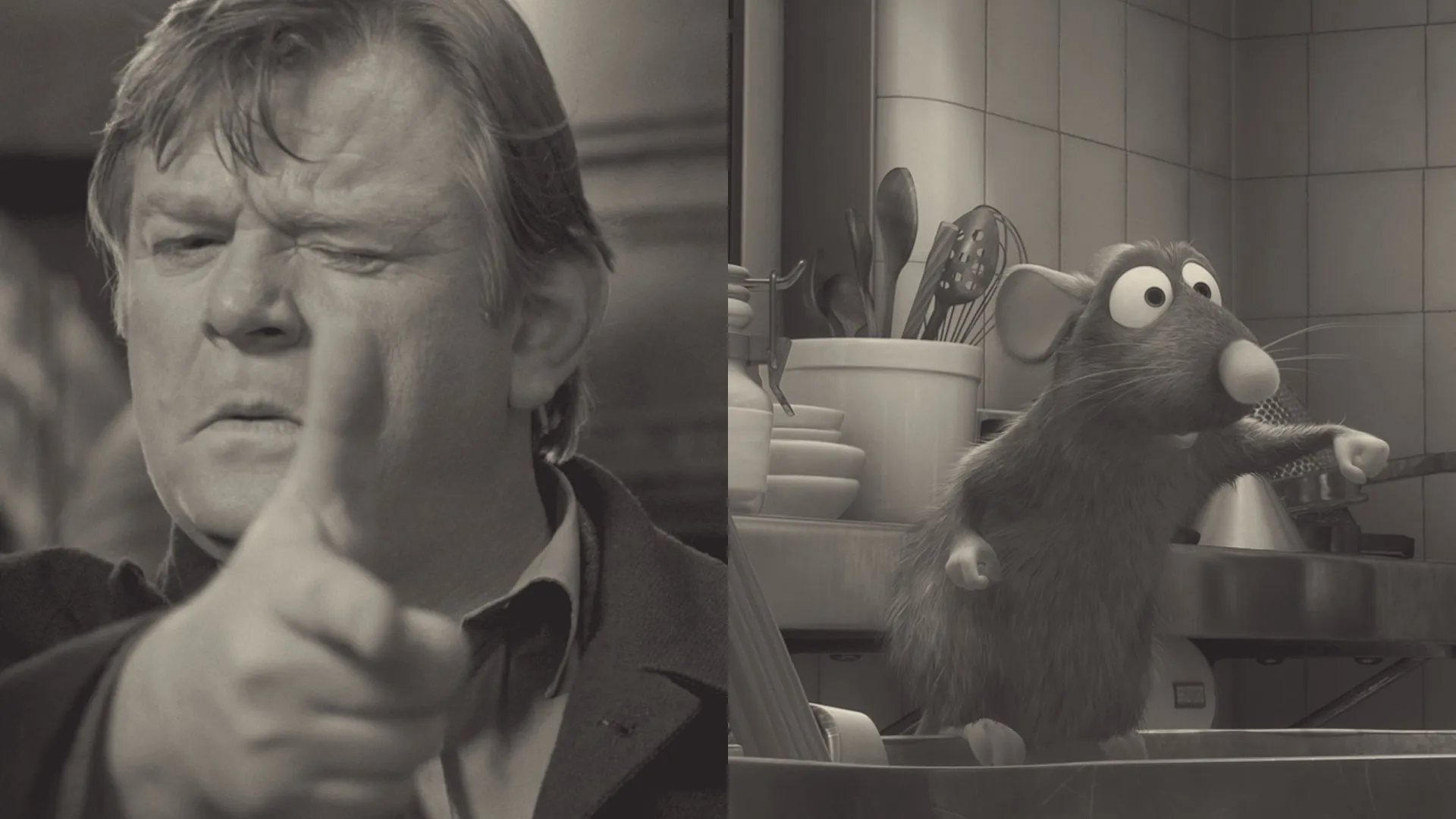
In Bruges and Ratatouille Are the Same Movie
One is a Pixar film about a rat who dreams of cooking in the best restaurant in Paris. The other is a profane, blood-slicked crime film about two hitmen hiding in a medieval Belgian town, waiting to learn which of them has to die. Nothing about them rhymes. Not the rating, not the tone, not the century they seem to belong to. Watch them back to back anyway, and both endings settle in the same place and hit with the same weight. A rat in one film, a hitman in the other. Both have spent the whole story hiding who they really are, and both, at the end, stop. The stopping risks everything. And it is worth it.
That shared landing isn’t an accident. It is the surface of a structure the two films hold in common, all the way down. Ratatouille and In Bruges are the same story. Not similar, the same. The same kind of protagonist, the same two characters around him, the same false victory at the middle, the same collapse, the same earned ending. It is why Anton Ego, the critic who could shutter the restaurant with one sentence, instead writes the kindest review of his life. It is why Harry, the gangster who runs all of In Bruges, turns the gun on himself. Both films end by holding a man to a rule he set for himself, and both make that feel like justice rather than plot. Once you can see the shape in two films this far apart, you stop being able to un-see it.
The same protagonist
Start with the protagonist, because both films build him the same way: a supreme talent lodged in the one identity least allowed to use it.
Remy is a rat who is the best cook in Paris. The contradiction is the whole character: vermin, the thing that gets a kitchen condemned, carrying the one gift a kitchen exists to reward. In Bruges runs the identical setup in a minor key. Ken is a career hitman who is, plainly, the most decent and fatherly man in any room he stands in — patient, curious, the only adult among children. A killer with the soul of a caretaker. Each has an Ironic Talent. The gifts differ, a chef’s and a father’s, but the irony is identical: the capability and the role point in opposite directions, and the gap between them is where the story lives.
Each protagonist also carries a Bad Habit: the one trait, unlike the talent, that can change, and the one the story will force him to shed. Remy lies, steals, and hides; it is what the colony taught him, and in the walls it reads as survival, not sin. Ken obeys. He follows Harry’s orders without putting his own conscience in front of them, because in the organization that raised him, obedience is loyalty and loyalty is how you stay alive. Neither habit looks like a flaw at first. That is the point. Home is not where the protagonist is safe; it is where his worst behavior is rewarded.
A note, since it trips people up: in In Bruges, Ken is the protagonist, even though he dies before the end. The story is his because the change is his. Ray gets the voiceover and the close-ups, but he is not the one who has to transform. He is the one Ken transforms for.
The same three characters
Neither film is built on a hero and a villain. Both are built on a Trifecta: three characters defined entirely by their relation to one another.
The Antagonist carries the same Bad Habit as the protagonist, but worse, and by choice rather than necessity. Skinner already runs Gusteau’s kitchen; he lies and defrauds not to survive but out of appetite, and he is a competent, uninspired cook, the protagonist’s talent without the irony. Harry sets the rules the whole underworld obeys, and is more enslaved to them than anyone; he is a brutish, mediocre father where Ken is a natural one. Each villain wants what the protagonist wants and fights him for it, which is what makes the conflict personal instead of a parade of obstacles.
The Muse is the inverse: lowest status, no talent at all in the domain that matters, and a Moral Strength that is the exact opposite of the protagonist’s Bad Habit, held to a fault. Linguini is the garbage boy who cannot cook a thing, and who is constitutionally unable to take credit he hasn’t earned or keep the secret he’s been handed. His honesty is the antidote to Remy’s hiding. Ray is a screw-up marked for death, a man with no moral perspective whatsoever, and who cannot stop following his own raw conscience, cannot perform the disciplined obedience that comes so easily to Ken. His self-direction is the antidote to Ken’s following. In both films the Muse never lectures. He just lives by the thing the protagonist lacks, until the protagonist sees it.
The same false victory
Both stories hand their protagonist a win at the exact middle, and both wins are won the wrong way.
Remy, steering Linguini by the hair, cooks his way to acclaim and a place in a real kitchen. In Ratatouille the apparatus is literal. Remy’s talent flows through Linguini’s body, and a rat in the kitchen stays hidden. It feels like he’s made it. But Remy is still under the hat, still concealed, still lying about who is doing the cooking. Ken, meanwhile, gets the thing he has been waiting for: an order. Harry phones and tells him to kill Ray. Whether Ken wants to carry it out is beside the point; the order itself is the prize, because a man who lives by obedience needs someone to obey. It hands him back the chain of command and the relief of not having to think for himself. It feels like solid ground. Both are still wearing the Bad Habit like armor. The victory looks total and is hollow, because nothing has actually changed.
The same way out
Then the cover gets stripped, and each is left with only his talent and the truth.
Remy is exposed. Caged, separated from the body that hid him, the secret out. He goes back anyway. He reveals himself to the kitchen staff, who walk out rather than cook beside a rat. Remy cooks the service regardless, his own family working the stoves with him. He doesn’t send out something impressive. He sends out ratatouille, a peasant dish, the most honest plate he has. Ego, the Judge, is disarmed by the food itself, before he has any idea what made it. Only afterward, with the dining room empty, does Remy let himself be seen. Ego writes the review that frees him. Remy reaches his Heaven on Earth by refusing to hide any longer: a kitchen of his own, out in the open, where he cooks as exactly what he is.
Ken’s version is the one that breaks your heart, and it is the same beat. Ordered to kill Ray, he finally hits the rule he cannot follow. And refuses. Stripped of the obedience that organized his whole life, he makes, for once, a decision entirely his own: he gives himself up to save the Muse. On the tower he takes Harry’s bullet and throws himself down to warn Ray, dying to buy him a life. Ken wins. Not by surviving — he doesn’t — but by reaching his own Heaven on Earth, which was never a restaurant or a victory. It was a clear conscience. One true choice, made by him, for someone else. And Harry, the Antagonist, is destroyed by his own Bad Habit held to the end: faced with what he believes is a child’s death, he enforces his own rule on himself and pulls the trigger.
Same final battle. The protagonist faces the man who shares his flaw, fights without the cover that hid it, and wins by being honest about who he is.
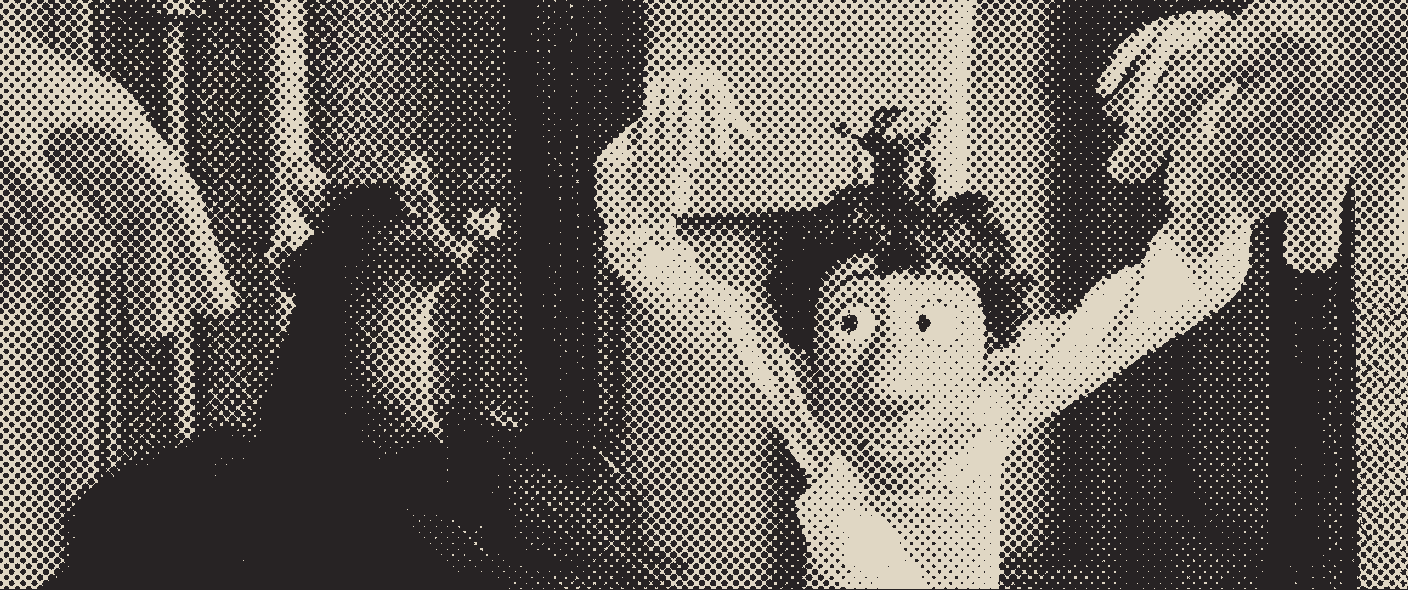
The same story, told twice
If these two films merely resembled each other, the likeness would show up in what they are about. It doesn’t. Write out what each is finally about, its one moral statement, and the two sentences share not a single image:
Ratatouille: The greatest chef can come from anywhere, as long as he is truthful about who he is.
In Bruges: A clear conscience comes from thinking and feeling for yourself, not from obedience.
Different worlds, different words, identical slot. That is what it means for structure to be load-bearing and surface to be free: the contradiction, the Trifecta, and the mirrored shape of the thing carry the story, while genre, tone, rating, and setting are paint. A rat and a hitman, a cartoon and a crime film, and underneath them one circle drawn the same way twice: the back half of each film answering the front half beat for beat, until both end exactly where they were always headed.
Tell the structure right and you can put any face on it you like. That is not a trick of these two films. It is the thing every story that lands is quietly doing.
Tale Spinning is a method that grows stories from theme and character outward. Every beat earned, every beat inevitable. Works whether you're writing your own, evaluating someone else's, or developing with a team, across screenplays, novels, comics, and stage plays.
Keep reading

May 9, 2026
Why Most Characters Don't Need a Character Arc
Every writing class says the same thing: all characters need arcs. Your protagonist needs an arc. Your antagonist needs an arc. Your sidekick needs an arc. This is bad- and impossible advice, and most characters in good stories do not have one. A look at what a character arc actually is, who has one, and why most of your supporting cast should stay still.
Read →
April 27, 2026
Mystic River and the Three Responses to One Wound
Mystic River opens with three eleven-year-old boys writing their names in wet cement. One of them gets taken. The other two grow up to become the protagonist and antagonist of one of the cleanest Kind Tragedies in modern cinema. A structural reading of how the same wound produces three different lives, and why this film, more than most, shows what happens when a Protagonist refuses to drop his Bad Habit.
Read →Every term used here is defined in the glossary.